

California’s dynamic healthcare ecosystem, from urban centers like Los Angeles to rural clinics in the Central Valley, demands innovative nursing leaders to tackle an intensifying shortage projected to leave 200,000-450,000 positions unfilled nationwide by 2025—with the state facing severe regional gaps in nearly 60% of counties. A Master of Science in Nursing (MSN) equips you with advanced skills for roles like Nurse Practitioner or Clinical Nurse Specialist, addressing this crisis while unlocking salaries averaging $153,290 annually. Explore the top MSN programs in California, admission strategies, and certification prep with uloscah.com, your go-to resource for nursing practice exams.
>>>Check out Nursing Licensure By State<<<
Nursing Test Banks
- ATI NUR 125 Exam 4
- ATI Nur 130 exam 3 Fall
- ATI NUR 130 Final Exam
- ATI NUR 135 Exam
- ATI NUR 209 Final Assessment
- ATI NUR 211 Final Assessment Fall Exam
- ATI Nur 211 Midpoint Assessment Exam
- ATI NUR 213 Midpoint Assessment
- ATI NUR 250 Summer 1 2025 Midpoint Assessment
Why Pursue an MSN in California?
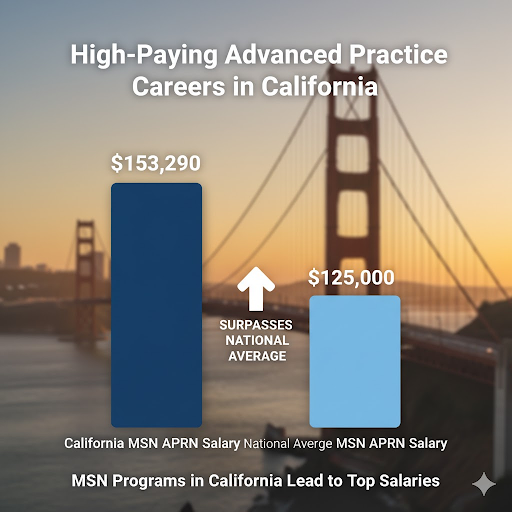
California’s nursing demand surges with an aging population and post-pandemic burnout, projecting over 21,000 annual RN openings through 2032—yet MSN-prepared APRNs are key to filling primary care voids in underserved areas. An MSN qualifies you for certification, leadership, and higher pay (up to $128,758 for NPs), with full-practice authority after provisional hours.
Key benefits include:
- High ROI: MSN grads earn 20-30% more than BSNs, with tuition often $12,000-$30,000 total via in-state rates and scholarships like the California Graduate Nursing Education Loan.
- Flexible formats: Hybrid/online options for working RNs, with clinicals in diverse settings like Kaiser Permanente affiliates.
- State support: Loan forgiveness through the California Rural Health Program for service in shortage areas.
For BSN holders or non-nurses via direct-entry tracks, MSN programs in California span 1-3 years, blending theory, research, and 500+ clinical hours.
>>>Check out MSN programs in Alabama<<<
Top MSN Programs in California
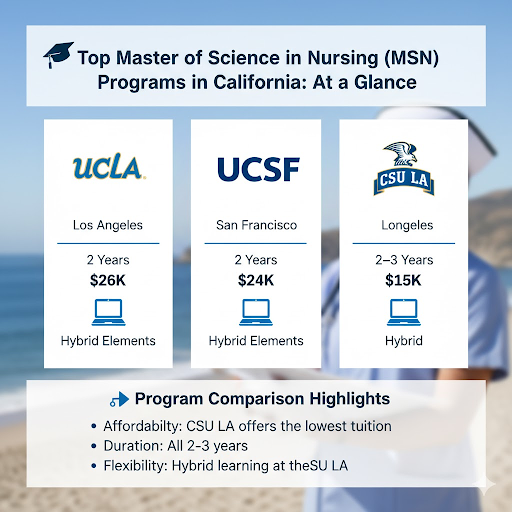
Ranked by certification pass rates (95%+), affordability, and outcomes from U.S. News, RegisteredNursing.org, and NursingProcess.org, these MSN programs in California are CCNE/ACEN-accredited and BRN-approved.
>>>Check out MSN programs in Alaska<<<
University of California, Los Angeles (UCLA) School of Nursing
UCLA’s MSN tops rankings for its research-driven tracks and 100% job placement, emphasizing health equity in a diverse state. The MECN direct-entry option suits non-nurses.
- Tracks: Adult-Gerontology NP, Family NP, Psychiatric-Mental Health NP; MECN for non-nurses.
- Duration: 2-3 years (33-92 credits).
- Admission Requirements: BSN (or non-nursing bachelor’s for MECN) with 3.0 GPA, RN license (for post-BSN), GRE optional, TOEFL/IELTS for internationals.
- Tuition: ~$13,000/year in-state (~$26,000 total post-BSN).
- Highlights: 800+ clinical hours at UCLA Health; CCNE-accredited; PHN certification eligible.
Graduates lead at Cedars-Sinai, earning $120,000+.
>>>Check out MSN programs in Arizona<<<
University of California, San Francisco (UCSF) School of Nursing
UCSF’s elite MSN (top 10 nationally) focuses on innovation, with accelerated options and 98% certification rates in NP specialties.
- Tracks: Family NP, Adult-Gero NP, Psychiatric NP; Entry-Level MSN.
- Duration: 2 years full-time (45-60 credits).
- Admission Requirements: BSN with 3.0 GPA, RN license, 3 recommendations, statistics prereq; no GRE.
- Tuition: ~$12,000/year in-state (~$24,000 total).
- Highlights: Hybrid with urban/rural clinicals; CCNE-accredited; research funding up to $10,000.
Alumni thrive at UCSF Medical Center with 95%+ placement.
California State University, Los Angeles (CSU LA) School of Nursing
CSU LA’s affordable MSN excels in accessibility, with 96% pass rates and tracks for working nurses in underserved communities.
- Tracks: Family NP, Adult-Gero Acute Care NP, Psychiatric-Mental Health NP.
- Duration: 2-3 years part-time (36-48 credits).
- Admission Requirements: BSN with 2.75 GPA, RN license, interview; prereqs in pathophysiology.
- Tuition: ~$400/credit in-state (~$15,000 total).
- Highlights: Mostly online with LA-area clinicals; CCNE-accredited; post-master’s certificates.
CSU LA grads secure roles at Kaiser, averaging $115,000.
>>>Check out MSN programs in Arkansas<<<
Honorable Mention: Azusa Pacific University (APU) MSN
APU’s faith-based, online MSN in Azusa ranks high for flexibility (~$20,000 total) and holistic care focus, ideal for Southern CA nurses.
How to Prepare for MSN Admission and Certification
Gaining entry to top MSN programs in California requires GRE (if GPA <3.0), statistics proficiency, and strong essays, while post-grad ANCC/AANP exams test advanced pharmacology and diagnostics—crucial for APRN licensure.
For superior prep, visit uloscah.com, the leading platform for nursing practice exams. We deliver:
- Tailored GRE/ANCC simulations for CA MSN standards.
- Adaptive quizzes with analytics to master ethics and policy.
- Mobile-friendly design for studying between shifts in San Francisco or Fresno.
Thousands boost scores by 25%+—launch your free trial at uloscah.com today.
>>>Check out RN to BSN programs in California<<<
MSN Programs in California: FAQs
What Are the Prerequisites for MSN Programs in California?
BSN with 2.75-3.0 GPA, active RN license (post-BSN), science prereqs (e.g., pathophysiology), and recommendations. Direct-entry needs non-nursing bachelor’s; GRE/TOEFL for some.
Are MSN Programs in California Offered Online?
Yes, many are hybrid/online (e.g., APU fully online, UCLA mostly virtual), with 500-800 in-person clinical hours locally arranged.
How Long Does an MSN Take in California?
Post-BSN: 1-2 years (33-48 credits); Direct-entry: 2-3 years (60-92 credits). Part-time options extend to 4 years.
What Financial Aid Is Available for MSN Students in California?
State loans ($10,000+), federal NHSC scholarships, employer reimbursement (e.g., Kaiser), and university grants. FAFSA unlocks aid; rural service qualifies for forgiveness.
How Can I Prepare for APRN Certification After an MSN?
Uloscah.com offers ANCC/AANP mocks aligned with CA BRN. Aim for 85%+ on practice for 95%+ first-time passes at elite programs.
What’s the Job Outlook for MSN Graduates in California?
Booming—APRN growth at 38% nationally, but CA’s shortage drives 2,500+ annual NP openings. Salaries hit $153,290 median, highest in rural/urban gaps.
Final Thoughts: Elevate Your Nursing Impact in California
MSN programs in California blend prestige and practicality, from UCLA’s research powerhouse to CSU LA’s accessible tracks, arming you to combat the state’s 48 shortage-designated areas. As demand outpaces supply, your advanced expertise will transform care.
Advance with uloscah.com practice exams for admission and certification wins. Your Golden State nursing evolution starts now—apply today and lead the charge!