
Advancing from an RN to a BSN is one of the smartest moves you can make for your nursing career. In Alabama, RN to BSN programs give you the flexibility to keep working while you learn, the affordability to make it possible, and the academic support to help you succeed. Whether your goal is career growth, higher pay, or preparing for graduate school, these programs are designed with working nurses in mind.
As the healthcare field continues to evolve, the BSN is quickly becoming the standard for many nursing roles. Earning your BSN builds on your existing skills, prepares you for leadership positions, and makes you a stronger candidate in a competitive job market. At uloscah.com, you’ll find resources to guide you every step of the way—from choosing the right program to preparing for coursework and exams.
>>>Check out Alabama Nursing License<<<
What Is an RN to BSN Program?
An RN to BSN program is designed for registered nurses who already hold an Associate Degree in Nursing (ADN) or a nursing diploma. These programs make it possible to complete your Bachelor of Science in Nursing in less time than a traditional four-year program, often in two years or less.
Why it matters:
- Career growth: A BSN is often required for leadership roles.
- Higher earning potential: BSN-prepared nurses generally earn more.
- Specialization: Provides a foundation for pediatrics, oncology, geriatrics, and more.
- Graduate study prep: A BSN is required for MSN and DNP programs.
Typical courses include: Nursing theory, community health, leadership and management, health assessment, and healthcare informatics.
>>>Read MSN programs in Alabama<<<
How to Get Started in Alabama
Here are the general steps to begin your RN to BSN journey in Alabama:
- Hold an ADN or Nursing Diploma from an accredited program.
- Maintain an active RN license in Alabama.
- Complete prerequisites (general education and nursing foundations).
- Apply to your chosen university and declare nursing as your major.
- Apply separately to the nursing program.
- Meet GPA requirements, usually between 2.5–3.0 depending on the school.
- Submit application materials, such as transcripts and a statement of intent.
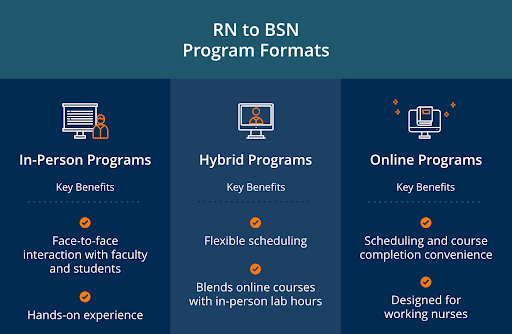
- Start your courses, either online, on campus, or through a hybrid program.
Why Choose an RN to BSN in Alabama?
- Higher salaries: BSN nurses often earn more than ADN-prepared nurses.
- Leadership roles: Positions like nurse manager, clinical leader, or educator often require a BSN.
- Better patient outcomes: Research shows BSN-prepared nurses contribute to improved care.
- Graduate opportunities: A BSN is your stepping-stone to MSN and DNP programs.
- Flexibility: Many Alabama schools offer fully online or hybrid programs tailored to working nurses.
Top RN to BSN Programs in Alabama
University of Alabama at Birmingham (UAB)
- 100% online and designed for working nurses.
- CCNE-accredited for quality assurance.
- Competitive tuition and financial aid options.
Auburn University
- Hybrid format with online courses and in-person clinicals.
- ACEN-accredited and focused on evidence-based practice.
- Evening classes for busy professionals.
University of South Alabama (USA)
- Fully online with a self-paced structure.
- CCNE-accredited and affordable tuition.
- Strong support for working nurses.
RN to BSN Programs for International Nurses
Many Alabama universities also welcome international students through online RN to BSN programs, including the University of South Alabama, Troy University, Auburn University at Montgomery, and the University of West Alabama.
What to know if you’re an international nurse:
- You may need to demonstrate English proficiency (TOEFL or IELTS).
- Credential evaluation may be required (CGFNS or equivalent).
- A valid U.S. work visa is needed to practice nursing here.
These programs are designed to help international RNs strengthen their knowledge and gain U.S. credentials to expand their opportunities.
Online RN to BSN Programs in Alabama
Online RN to BSN programs are increasingly popular because they allow nurses to continue working while pursuing their degree. Programs like UAB’s and USA’s provide asynchronous courses, meaning you can log in and study on your own schedule.
Benefits of online programs include:
- Flexibility to study from anywhere.
- Balance between work, school, and family life.
- No commuting or relocation costs.
>>>See also ATI Pharmacology Proctored Exam <<<
Cost of RN to BSN Programs in Alabama
Most RN to BSN programs in Alabama cost $340–$399 per credit hour, with total tuition around $11,000–$12,000 for 30 credit hours.
Examples:
- Auburn University at Montgomery: ~$11,040–$11,670 total.
- University of North Alabama: $340 per credit hour.
- University of Alabama: $399 per credit hour.
- University of Mobile: $375 per semester hour.
Ways to save:
- Apply for nursing scholarships and grants.
- Use employer tuition reimbursement.
- Ask about flexible payment plans.
How Uloscah.com Supports Your Journey
At uloscah.com, we know that preparing for an RN to BSN program can feel overwhelming. That’s why we provide resources that make it easier:
- Application tips for submitting strong materials.
- Exam prep tools like practice tests and study guides.
- Program comparisons so you can choose the right school.
- Career resources including resume and interview help.
We’re here to help you not only get into the right RN to BSN program but also thrive throughout your nursing journey.
RN to BSN Programs in Alabama: FAQs
How Long Does It Take?
Most programs can be completed in 12–24 months full-time, or 3–4 years part-time.
Are Online Options Available?
Yes. Many universities, including UAB, USA, UNA, and Troy, offer fully online RN to BSN programs.
Can I Work While in the Program?
Absolutely—these programs are built for working nurses and offer flexible schedules.
What’s the Admission Requirement?
You’ll need an ADN or diploma in nursing, an unencumbered RN license, and a minimum GPA (often 2.5 or higher).
Conclusion
Earning your RN to BSN in Alabama is more than just a degree upgrade—it’s an investment in your future. With options ranging from fully online to hybrid programs, affordable tuition, and strong support systems, Alabama makes it possible for working nurses to take this important step without putting their lives on hold.
Whether you’re aiming for leadership roles, graduate school, or simply want to strengthen your skills, completing a BSN opens doors that an ADN cannot. With guidance from uloscah.com, you’ll have the resources and support you need to apply confidently, succeed academically, and take your nursing career to the next level.